
How to Write Hooks for AI UGC Videos
· UGC Video · 8 min read · Reels Farm Team
AI can help you build more UGC variations, but volume does not fix weak openings. The first line still has to do real work if you want the rest of the video to get watched.
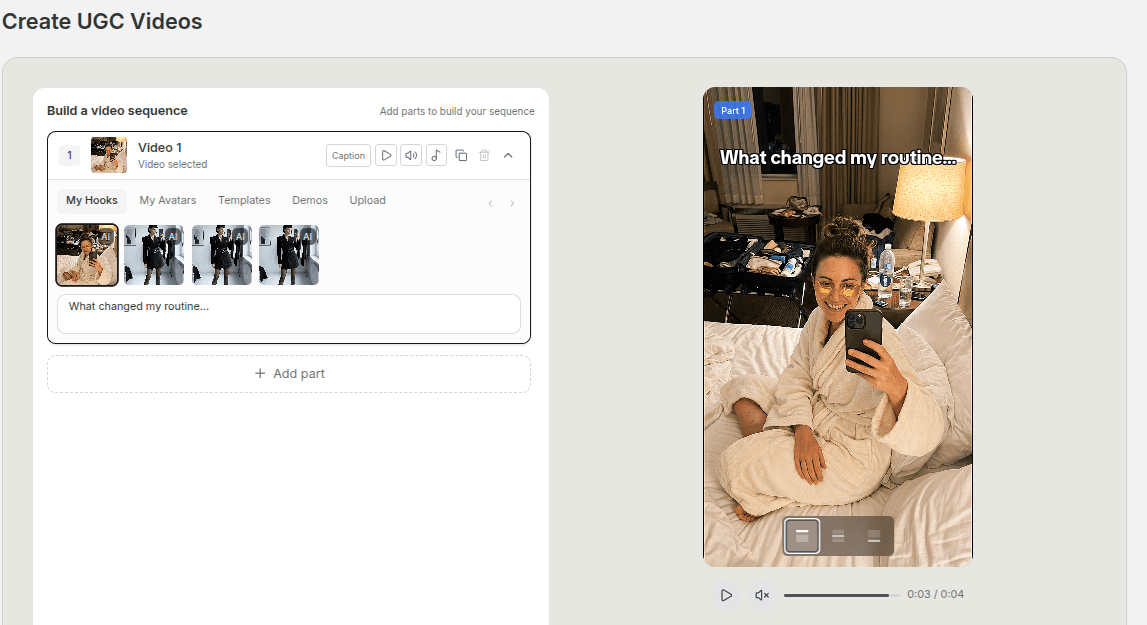
The hook is where most UGC videos win or die.
That is even more true when AI is involved, because weak openings get exposed fast. If the first line sounds generic, viewers assume the rest of the video will be generic too.
The good news is that hook writing is less mysterious than people make it sound.
Quick Answer
Strong hooks for AI UGC videos usually have four qualities:
- They focus on one tension point.
- They sound like speech, not website copy.
- They fit the footage that follows.
- They create a reason to keep watching immediately.
If the hook is vague, overstuffed, or disconnected from the rest of the sequence, the video starts heavy and rarely recovers.
Step 1: Pick the Right Hook Type
You do not need endless creativity to write better hooks. You need to choose the right type of opening for the angle.
The most useful hook types in UGC are:
Problem hooks
These start with a pain point the audience already knows.
Mistake hooks
These call out a behavior or assumption that creates curiosity.
Result hooks
These lead with the outcome and let the rest of the video explain why it happened.
Direct product hooks
These put the product or product use case up front when the offer is already compelling enough.
The mistake is mixing several hook types together in one sentence. Pick the one that fits the video best, then build around it.
Step 2: Match the Hook to the Product Angle
Good hook writing gets easier when the product angle is already clear.
If your video is about convenience, the opening should frame convenience.
If your video is about a visible result, the opening should point toward the result.
If your video is about one specific mistake, the opening should make the mistake feel relevant quickly.
That sounds simple, but it solves a very common problem. Many UGC hooks are written in isolation. The writer creates a clever opening, then the rest of the video tries to catch up to it.
That creates disconnect.
The hook should feel like the first sentence of the same argument the video will continue making.
Step 3: Keep the Language Short and Spoken
Most weak hooks fail at the sentence level.
They use too many words. They explain too much. They sound like copy that was polished until all the life came out of it.
Stronger hooks usually have:
- shorter sentences
- one main thought
- concrete language
- spoken rhythm
A useful editing rule is to cut anything the audience does not need to understand in the first second.
You can always add nuance later.
The hook only needs to earn the next part of the sequence.
Step 4: Write Variations Before Choosing One
This is where AI-assisted workflows can help if you use them correctly.
Do not ask for one hook and move on.
Generate or write several. Then keep only the ones that fit the footage, the product, and the tone of the video.
A simple process works well:
- write one direct hook
- write one problem hook
- write one curiosity hook
- write one result hook
- compare them against the same middle section
This reveals a useful truth quickly. Some hooks sound good alone but collapse once they have to carry the actual demo that follows.
Step 5: Make Sure the Video Delivers on the Hook
A hook is a promise.
If the rest of the video does not support it, the viewer feels the mismatch immediately.
This is why hook writing and sequencing belong close together. If your workflow lets you swap openings without rebuilding the entire edit, you can find stronger combinations faster.
Check the hook against three things:
- does the next shot support it?
- does the middle build belief around it?
- does the ending resolve it?
If the answer is no, fix the sequence or rewrite the hook.
Useful Hook Tests
Before locking the final line, run a few simple tests:
Can I say it out loud without sounding unnatural?
If not, it probably needs to be simpler.
Would the next shot make sense under this opening?
If not, the hook is probably mismatched.
Does the line point toward one clear outcome or tension?
If not, it may be trying to do too much.
Would this hook still work if the brand name were removed?
If yes, it is more likely to feel native and less like a slogan.
Common Mistakes
Writing hooks that could fit any product
If the opening could belong to twenty other ads, it probably lacks bite.
Overexplaining in the first line
The hook should open the loop, not close the entire argument at once.
Using polished ad language that nobody would say
Short-form openings perform better when they sound closer to speech.
Promising something the video never proves
This is one of the fastest ways to make AI UGC feel hollow.
FAQ
How long should a UGC hook be?
Usually shorter than people think. Many strong hooks work because they get to the point quickly.
Should the hook be on-screen text, spoken audio, or both?
Any of those can work. The important thing is clarity and fit with the rest of the sequence.
Do I need a new hook for every variation?
Not always, but changing the hook is one of the fastest ways to create meaningfully different versions from the same core video.
Final Take
Better hooks come from better alignment.
The opening line needs to match the angle, the footage, and the promise the rest of the video can actually fulfill. If your UGC workflow lets you test several hooks against the same demo or supporting clips, you can improve the strongest part of the video without rebuilding everything else.
Related tools
If you want to turn this topic into something usable right now, start with these tools.
TikTok Hook Generator
Generate TikTok hook ideas for product demos, lessons, and founder-led content.
TikTok Caption Generator
Create short TikTok captions for demos, lessons, proof posts, and quick takes.
CTA Generator
Create call-to-action lines for captions, carousels, videos, and offer-led posts.
UGC Script Generator
Build UGC-style script outlines for testimonials, demos, and problem-solution videos.
Related reading
- This Is Why Your UGC Videos Are Stuck at 200 Views
A strong UGC format can still stall if the account has not been warmed up around the right audience, niche, and engagement signals.
- Best UGC Video Structure for Product-Led Short-Form Ads
Most weak UGC ads have a structure problem. The strongest ones move from hook to proof to payoff without wasting the middle.
- How to Turn One Product Demo Into Multiple UGC Video Variations
Real variation usually comes from changing the message around a demo, not from pretending tiny edits create a whole new ad.
- Why Some AI Videos Get Shared and Others Get Ignored
AI videos get shared when they give people something worth passing along, not just something polished to watch.
- The Complete Guide to Scraping Viral Hooks for Short-Form Content
The most reliable way to improve your hooks is to stop writing from scratch. Start with what is already working.
- Why Your Hooks Are Failing (And How Scraping Viral Hooks Fixes It)
Most failing hooks share the same root cause. They were written in isolation, never tested, and never compared against what is actually working right now.
Related comparisons
- Best AI UGC Video Tools for Short-Form Content
A buying guide to AI UGC video tools, with ReelsFarm positioned for complete short-form content workflows.
- Best TikTok Automation Tools for Content Teams
A guide to TikTok automation tools for teams that need content creation, scheduling, publishing, and creative control.
- Best AI Slideshow Makers for TikTok
A guide to AI slideshow makers for TikTok, with ReelsFarm positioned for repeatable slideshow automation.
- Best AI UGC Tools for Ecommerce Brands
A source-checked guide to six AI UGC tools for ecommerce product content and publishing workflows.
Drive traffic to what matters on autopilot.
Create standout posts, line up your calendar, and publish consistently without juggling a dozen tools.