
Best Short-Form Content Calendar for Mixed Formats
· Publishing Workflow · 8 min read · Reels Farm Team · Updated
A lot of calendars look organized while hiding weak production flow underneath. The best ones do more than show dates. They make the next publishing decisions easier.
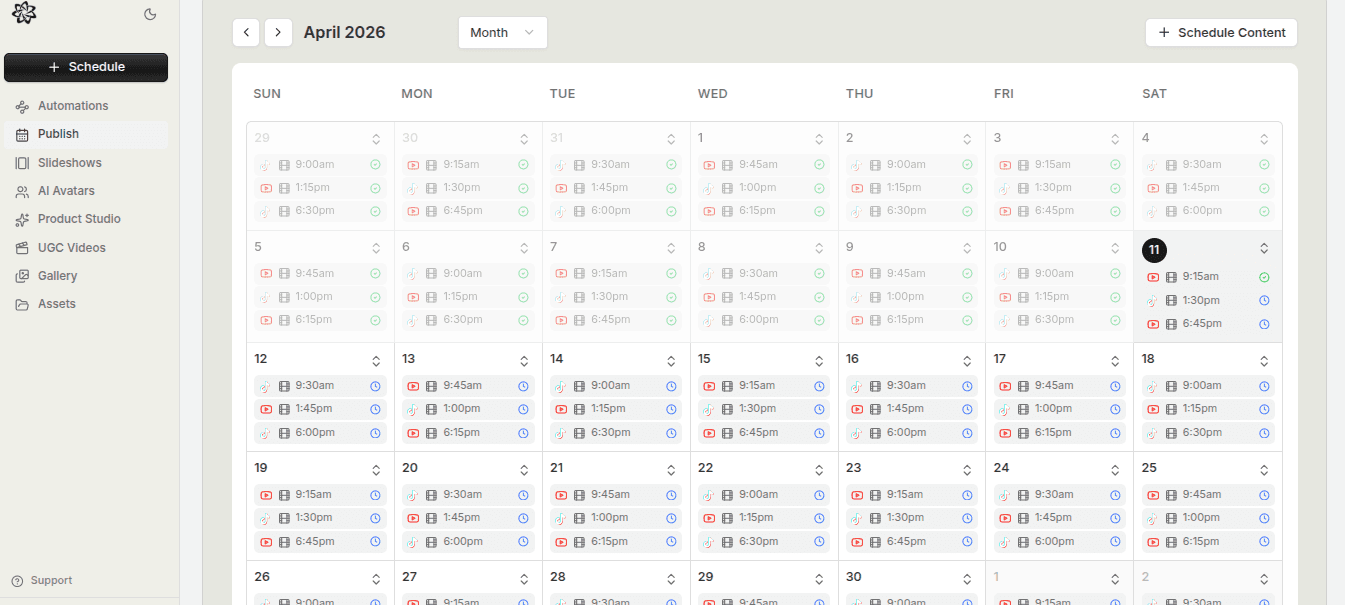
A short-form content calendar should reduce decisions, not create more of them.
That sounds basic, but many calendars fail this test. They show dates well enough, but they hide readiness, blur format differences, and make it hard to understand what the month is actually trying to accomplish.
Quick Answer
The best short-form content calendar for mixed formats should show:
- what the content is
- where it is going
- when it is scheduled
- whether it is ready
- how it fits the month as a whole
If the calendar makes those things obvious, it becomes much more useful as a publishing tool.
Section 1: What the Calendar Needs to Show
At minimum, a strong mixed-format calendar should make these fields clear:
- format
- destination
- date
- time
- readiness
Why those five?
Because most publishing problems come from one of them being unclear. The team thinks the post is ready when it is not. The destination is assumed instead of confirmed. The format mix gets lopsided because nobody sees it at a glance. The time is set, but the month still feels incoherent.
The best calendars make these mistakes harder to make.
Section 2: How to Balance the Month
A strong monthly view should help you spot pattern problems quickly:
- too many similar posts in one week
- too many of the same format back to back
- weak gaps in the second half of the month
- strong assets stacked too tightly
This is where the calendar becomes strategic. It is no longer just about what got scheduled. It is about whether the publishing rhythm makes sense.
That matters even more in mixed-format systems because several different production paths are feeding the same month.
Section 3: What Teams Usually Miss
Most calendars are weaker than they look because they hide one of three things:
- readiness
- ownership
- destination clarity
Readiness is especially important. A post with a slot on the calendar is not automatically a post that is ready to publish. Once that difference gets hidden, the month starts lying to the team.
Ownership matters too. Someone should be able to tell who is responsible for moving the asset forward.
Destination clarity matters because short-form workflows often involve several platforms, accounts, or formats that can easily be confused if the calendar is too abstract.
Section 4: The Calendar Should Reduce Weekly Decisions
A useful calendar makes publishing week easier.
It should help the team answer:
- what still needs finishing?
- what is already safe to publish?
- where are the next gaps?
- which format should be produced next?
If the team still needs a separate mental map to answer those questions, the calendar is not doing enough.
Section 5: Mixed Formats Need Shared Visibility
One reason mixed-format calendars fail is that each format becomes its own silo.
Slideshows live in one process. UGC videos live in another. Avatar posts live somewhere else. Then the monthly view becomes an afterthought instead of the place where all of that work actually meets.
A better calendar gives shared visibility without pretending every format follows the same production path.
That balance is important.
Common Mistakes
Treating the calendar like a storage board
A calendar should guide publishing, not just hold items.
Hiding readiness behind a scheduled slot
A date on the calendar does not guarantee publish readiness.
Ignoring format balance
Mixed formats need visible distribution, not accidental clustering.
Leaving destination details too abstract
Publishing gets riskier when destination clarity is weak.
FAQ
Is month view or week view more important?
Both matter. Month view is stronger for pattern recognition. Week view is stronger for execution.
Should every post have the same level of detail in the calendar?
Not necessarily, but every post should still make the key publishing information clear.
Can one calendar work for several short-form formats?
Yes, as long as the system makes format roles and readiness visible enough to stay coherent.
Final Take
The best short-form content calendar is the one that makes the month understandable under real production pressure.
If format, readiness, timing, and destination stay visible, mixed-format publishing gets much easier to manage. That is what turns the calendar into a real operational tool instead of a neat-looking layer on top of a messy workflow.
Related tools
If you want to turn this topic into something usable right now, start with these tools.
Content Angle Generator
Generate content angles you can turn into hooks, captions, slideshows, or scripts.
Free Caption Formatter
Format TikTok and Instagram captions with cleaner spacing and line breaks. Keep your original wording, review the result, and copy it for posting.
Instagram Caption Generator
Create Instagram caption drafts for stories, lessons, launch posts, and offers.
Slideshow Outline Generator
Create carousel and slideshow outlines for educational, promotional, and story-led posts.
Related reading
- How to Organize Slideshows, UGC Videos, and Avatar Posts in One Calendar
Mixed-format calendars work better when each format has a clear role and the schedule stays visible while the content is still being produced.
- How Far in Advance Should You Schedule Short-Form Content?
Most teams should schedule repeatable content ahead of time while leaving enough space for reactive posts and still-unproven ideas.
- How to Schedule 30 Days of Short-Form Content in One Sitting
A month of content in ninety minutes. It is possible when you stop making videos one at a time and start building a batch production system.
- How Often Should You Post TikTok Slideshows?
A strong posting cadence gives the account enough repetition to learn without pushing the creative standard downhill.
- TikTok Post Scheduler: What Actually Matters Before You Choose a Tool
Most scheduler comparisons focus on feature lists. The better comparison is how fast the tool gets you from finished content to a clean publish calendar.
- Best Instagram and Facebook Schedulers for Multiple Accounts (2026)
The account limit can matter as much as the scheduler. Compare how these tools count Instagram profiles and Facebook Pages before you connect them.
- Best AI Social Media Automation Tools (2026)
“Automation” can mean drafting a caption, filling a queue, or publishing without review. These tools cover different levels of social media work.
- Best Cross-Posting Tools for Short-Form Video (2026)
Cross-posting can save time, but the tool should make each destination clear and let you adjust the post for that platform.
Related comparisons
- Best AI UGC Video Tools for Short-Form Content
A buying guide to AI UGC video tools, with ReelsFarm positioned for complete short-form content workflows.
- Best TikTok Automation Tools for Content Teams
A guide to TikTok automation tools for teams that need content creation, scheduling, publishing, and creative control.
- Best AI Slideshow Makers for TikTok
A guide to AI slideshow makers for TikTok, with ReelsFarm positioned for repeatable slideshow automation.
- Best AI UGC Tools for Ecommerce Brands
A source-checked guide to six AI UGC tools for ecommerce product content and publishing workflows.
Drive traffic to what matters on autopilot.
Create standout posts, line up your calendar, and publish consistently without juggling a dozen tools.