
How Far in Advance Should You Schedule Short-Form Content?
· Publishing Workflow · 8 min read · Reels Farm Team
Teams often make one of two mistakes. They either schedule too far ahead and lock weak content in place, or they stay too close to the deadline and spend every week in cleanup mode.
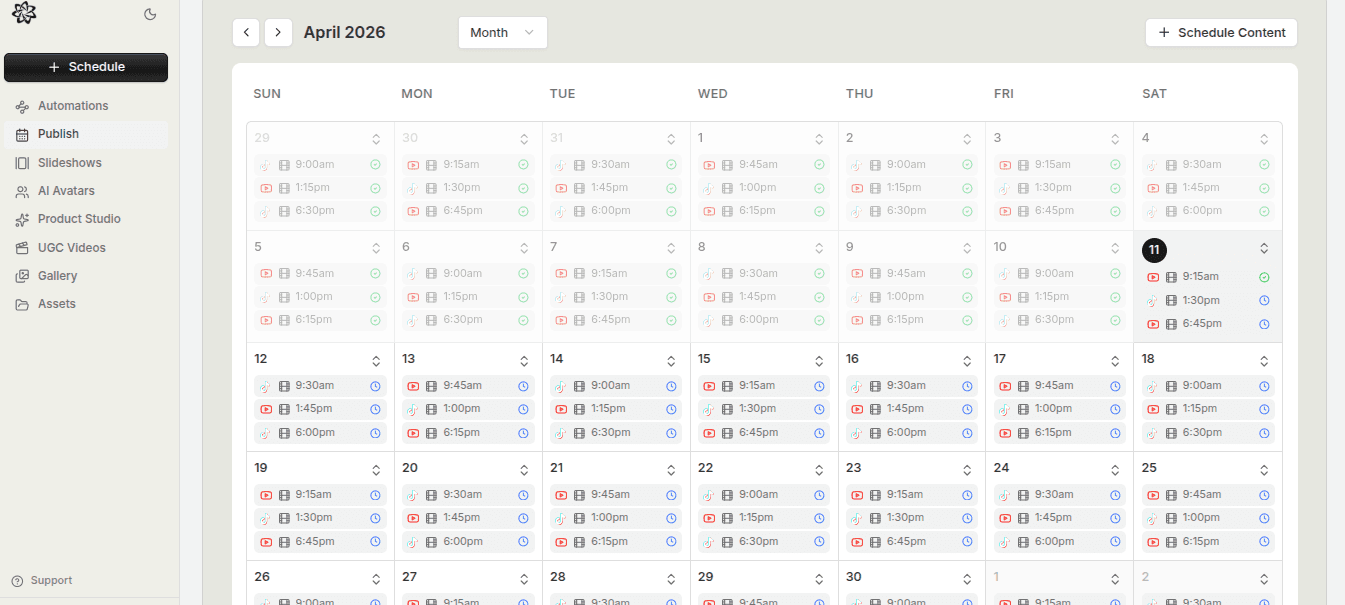
There is no perfect universal scheduling horizon.
But there is usually a useful one for your workflow.
If you schedule too far ahead, weak content gets locked in and flexibility disappears. If you schedule too close to publish time, the team stays stuck in reaction mode and consistency gets harder to maintain.
Quick Answer
For most short-form teams, the healthiest rule is:
- schedule repeatable content ahead of time
- keep reactive or trend-sensitive content more flexible
- build review time into the schedule window
In many cases, that means working one to two weeks ahead for stable output and using monthly planning more as a structure than a fully locked calendar.
Section 1: What Belongs on the Calendar Early
Some content benefits from being scheduled well in advance because it is relatively repeatable.
That often includes:
- slideshows built from proven formats
- evergreen UGC-style sequences
- recurring educational posts
- campaign assets tied to known dates
These formats usually become easier to schedule early because the creative risk is lower. The team is not guessing from scratch every time.
Section 2: What Should Stay Flexible
Not everything deserves a locked slot too early.
Content that should usually stay more flexible includes:
- reactive posts
- trend-dependent ideas
- experimental formats
- content that still needs validation
This is where many teams get burned. They confuse planning with certainty. Then the calendar looks full, but half the month is carrying ideas that were never strong enough to deserve fixed dates.
Section 3: How Far Ahead Is Actually Useful
A simple working model helps:
Weekly
Useful for teams still shaping the workflow or publishing mostly reactive content.
Biweekly
Often the best balance for teams with repeatable short-form formats and an active review loop.
Monthly
Best when the team already has stable production and wants more distribution clarity across the whole month.
The right answer depends less on ambition and more on repeatability. The more stable the content engine is, the further ahead scheduling becomes genuinely useful.
Section 4: Build Review Time Into the Lead Time
A lot of scheduling problems are actually review problems.
The team wants to schedule earlier, but the content is still waiting on:
- caption review
- brand check
- final edit approval
- destination decisions
That is why lead time should include review time, not just content creation time. If there is no buffer for review, the calendar becomes fragile even when it looks full.
Section 5: Use Planning and Scheduling Differently
This is a useful distinction.
Planning can happen further ahead than final scheduling.
For example, the month can be mapped early:
- which weeks need slideshows
- which weeks need UGC videos
- which campaign pushes are coming
Then the exact posts can be locked as they become truly publish-ready.
That keeps the calendar structured without pretending every slot is already final.
Common Mistakes
Locking weak posts too early
A full calendar is not the same as a strong calendar.
Staying too close to the deadline
This turns scheduling into constant recovery work.
Forgetting to leave room for flexible content
Not everything should be treated as fixed weeks ahead of time.
Ignoring the review bottleneck
Scheduling speed often depends on review quality more than calendar quality.
FAQ
Should every short-form format follow the same lead time?
Not necessarily. Repeatable formats can often be scheduled earlier than reactive or experimental ones.
Is monthly planning still useful if I do not lock every post that early?
Yes. Monthly planning is often valuable even when exact post scheduling stays more flexible.
How do I know if I am scheduling too far ahead?
If the calendar keeps filling with weak or unfinished content that later needs rework, the horizon is probably too aggressive.
Final Take
The best scheduling horizon is the one that gives your team structure without freezing weak decisions in place.
Plan further ahead than you finalize, schedule proven content earlier, and keep room for flexible posts where flexibility still matters. That balance is what keeps short-form publishing organized without making it rigid.
Related tools
If you want to turn this topic into something usable right now, start with these tools.
Content Angle Generator
Generate content angles you can turn into hooks, captions, slideshows, or scripts.
Free Caption Formatter
Format TikTok and Instagram captions with cleaner spacing and line breaks. Keep your original wording, review the result, and copy it for posting.
Instagram Caption Generator
Create Instagram caption drafts for stories, lessons, launch posts, and offers.
Related reading
- How to Build a Repeatable Publish Queue for Short-Form Content
A repeatable publish queue depends on clear readiness rules, visible prioritization, and a clean handoff from creation into scheduling.
- Best Short-Form Content Calendar for Mixed Formats
The best short-form calendar makes format, readiness, timing, and destination visible enough that the month stays coherent.
- How Often Should You Post TikTok Slideshows?
A strong posting cadence gives the account enough repetition to learn without pushing the creative standard downhill.
- TikTok Post Scheduler: What Actually Matters Before You Choose a Tool
Most scheduler comparisons focus on feature lists. The better comparison is how fast the tool gets you from finished content to a clean publish calendar.
Related comparisons
- Best AI UGC Video Tools for Short-Form Content
A buying guide to AI UGC video tools, with ReelsFarm positioned for complete short-form content workflows.
- Best TikTok Automation Tools for Content Teams
A guide to TikTok automation tools for teams that need content creation, scheduling, publishing, and creative control.
- Best AI Slideshow Makers for TikTok
A guide to AI slideshow makers for TikTok, with ReelsFarm positioned for repeatable slideshow automation.
- Best AI UGC Tools for Ecommerce Brands
A source-checked guide to six AI UGC tools for ecommerce product content and publishing workflows.
Drive traffic to what matters on autopilot.
Create standout posts, line up your calendar, and publish consistently without juggling a dozen tools.