
When to Use Product Studio vs Traditional Product Photography
· Product Studio · 8 min read · Reels Farm Team
The real question is usually not which approach is better forever. It is which one fits the asset, campaign, and time pressure in front of you right now.
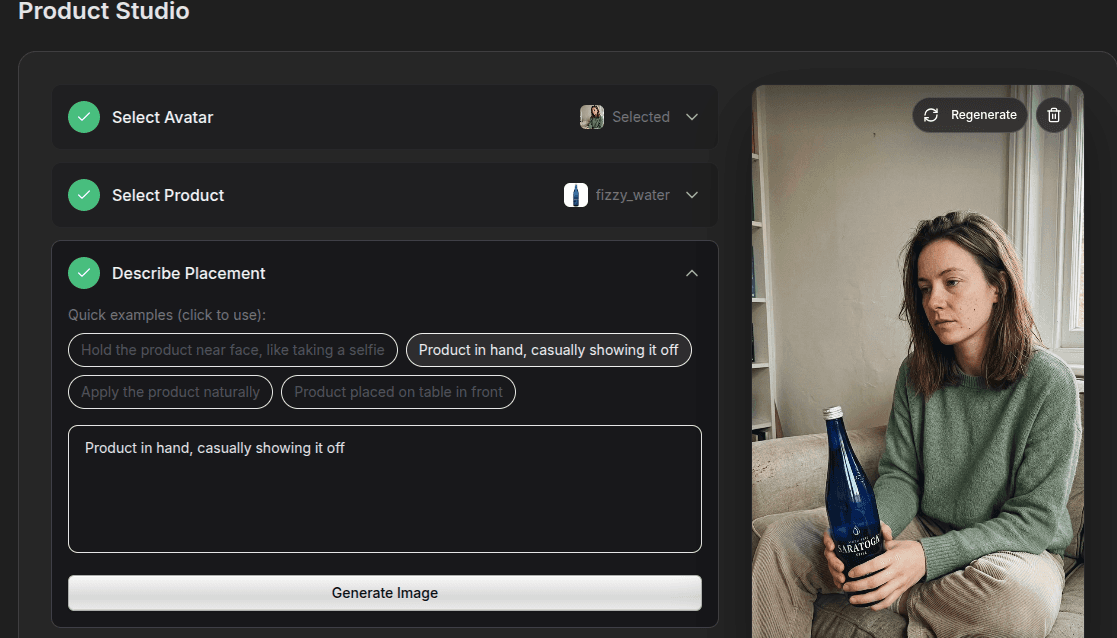
Product Studio and traditional product photography are often compared as if one should replace the other.
That is usually the wrong frame.
Both are useful. They just solve different creative problems.
Quick Answer
Use Product Studio when you need:
- more speed
- more visual variation
- faster campaign support
- more flexible product-led creative built from existing assets
Use traditional product photography when you need:
- highly accurate hero product shots
- packaging precision
- brand-standard detail capture
- physical realism as the main requirement
Many brands will get the best result by combining both.
Where Product Studio Wins
Product Studio is strongest when the team needs more creative volume and faster turnaround.
It is especially useful for:
- campaign refreshes
- ad variation
- creator-style product visuals
- product-in-hand concepts
- launch support when time is tight
The biggest advantage is flexibility. Once good product assets and characters are available, the team can build several useful concepts without waiting on a new shoot every time. That is why AI product placement works well for product-in-hand and creator-style variations.
Where Traditional Product Photography Wins
Traditional photography still has clear strengths.
It is often the better choice when the output needs:
- exact packaging representation
- premium hero product precision
- catalog-grade realism
- highly controlled brand-standard visuals
This is especially true when the product itself is the whole message and every detail needs to be captured exactly as it exists in the physical world.
Where They Work Best Together
This is usually the most practical answer.
Strong real product assets can feed composited workflows later. That means a brand can use:
- traditional photography to establish a clean source library
- Product Studio to extend that library into campaign-ready variations
That combination often creates more leverage than forcing either approach to do everything alone.
Choose Based on the Output
A better decision framework is to ask what you actually need:
Hero ecommerce image
Traditional photography may have the edge if detail accuracy is the top priority.
Product-led ad variation
Product Studio may be faster and more useful.
Creator-style product presentation
Product Studio often opens more flexible options.
Launch support with multiple concepts
A composited workflow may help the team move faster.
Once the output is clear, the workflow decision gets easier.
Think About Time Pressure and Reuse
Another practical difference is reuse.
Traditional photography usually creates strong source material.
Product Studio often creates faster creative extensions from that material.
If the brand needs one carefully controlled product image, photography may be the better move. If the brand needs ten campaign-supporting variations over the next few weeks, the composited path may offer more leverage.
Common Mistakes
Treating the two workflows like direct substitutes in every situation
They are not solving the same creative need every time.
Expecting Product Studio to replace precise hero photography
That is often the wrong benchmark.
Expecting photography alone to solve fast variation needs
That can become slow and expensive quickly.
Ignoring the value of combining both
Some of the best systems come from using real assets inside faster creative workflows.
FAQ
Which approach is better for paid social?
Either can work. Product Studio often helps more when the team needs several campaign-ready variants quickly.
Do brands still need real product photography?
Often yes, especially when high-accuracy source assets matter.
Can Product Studio support ecommerce brands with existing product photos?
Yes. In many cases, existing product assets make composited workflows more useful, not less.
Final Take
Product Studio and traditional product photography are best treated as complementary tools.
Use photography when exact product capture matters most. Use Product Studio when speed, variation, and flexible campaign creative matter more. The strongest systems often start with real product assets and then extend them into faster creative workflows later.
Related tools
If you want to turn this topic into something usable right now, start with these tools.
Content Angle Generator
Generate content angles you can turn into hooks, captions, slideshows, or scripts.
Instagram Caption Generator
Create Instagram caption drafts for stories, lessons, launch posts, and offers.
CTA Generator
Create call-to-action lines for captions, carousels, videos, and offer-led posts.
Related reading
- How to Make Product-Led Social Images Without a Studio Shoot
Product-led social images work when the product stays central and the creative direction supports the offer instead of distracting from it.
- How to Build Product Ad Variations Faster With AI Compositing
Fast product variation comes from reusing the core asset and changing scene, framing, avatar role, or offer angle deliberately.
- Fitness Product Photos for Gyms and Pilates Studios
Show the studio merchandise or welcome kit members can buy. Keep the product, contents, and setting clear.
Related comparisons
- Best AI UGC Video Tools for Short-Form Content
A buying guide to AI UGC video tools, with ReelsFarm positioned for complete short-form content workflows.
- Best TikTok Automation Tools for Content Teams
A guide to TikTok automation tools for teams that need content creation, scheduling, publishing, and creative control.
- Best AI Slideshow Makers for TikTok
A guide to AI slideshow makers for TikTok, with ReelsFarm positioned for repeatable slideshow automation.
- Best AI UGC Tools for Ecommerce Brands
A source-checked guide to six AI UGC tools for ecommerce product content and publishing workflows.
Drive traffic to what matters on autopilot.
Create standout posts, line up your calendar, and publish consistently without juggling a dozen tools.