
How to Turn One Product Angle Into 10 TikTok Slideshow Variations
· Content Variations · 8 min read · Reels Farm Team
Once you have one product angle that works, the next job is not to abandon it. The next job is to stretch it into several strong versions without making the feed feel repetitive.
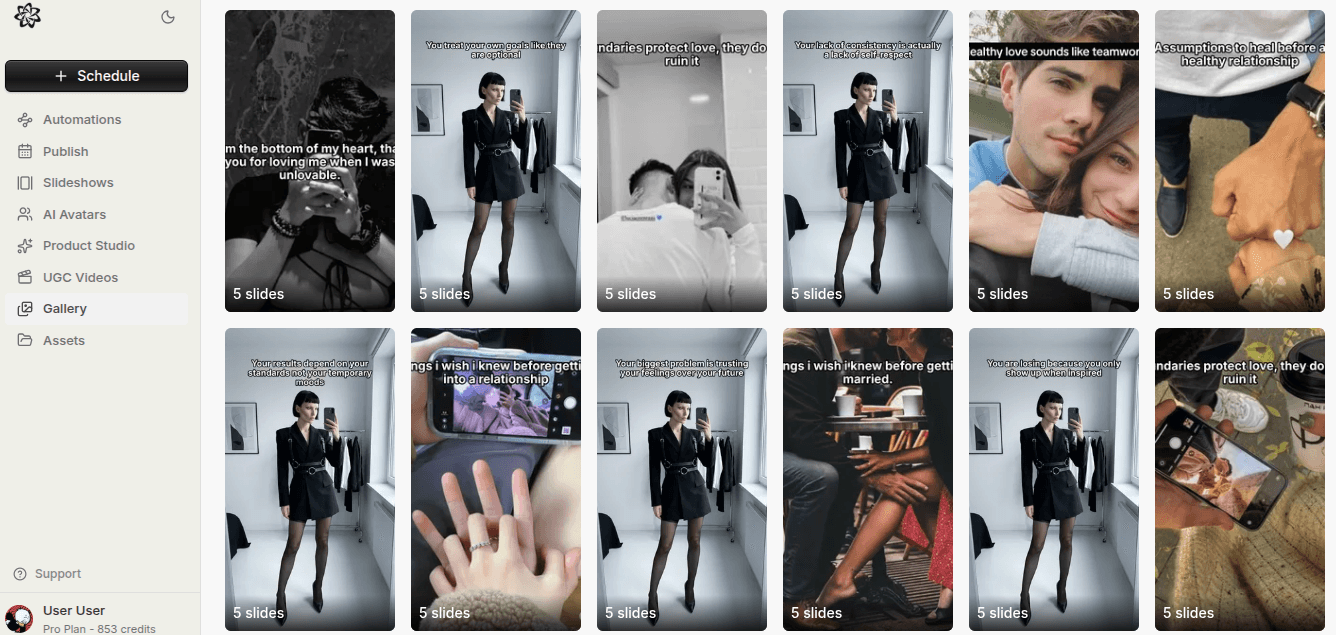
Many teams have one decent product angle and no system for turning it into a series.
That leaves a lot of value on the table. A good angle should not produce one post. It should produce a family of posts with different entry points.
Quick Answer
To turn one product angle into multiple slideshow variations, keep the core claim stable and change the surface layers:
- the hook
- the proof
- the visual treatment
- the audience framing
- the CTA placement
That gives you variation without losing the point of the post.
Step 1: Define the Core Angle Clearly
Before you can build variations, the underlying angle has to be sharp.
A clear angle might sound like:
- this workflow saves time for a specific kind of user
- this format makes subtle selling easier
- this product removes one painful manual step
If the angle is fuzzy, the variations get fuzzy too.
You want one sentence that explains what the post is really trying to prove.
Step 2: Change the Hook, Keep the Core Message
The easiest variation lever is the hook.
One angle can support several first-slide entries:
- a problem-first hook
- a strong opinion
- a curiosity hook
- a direct result
That gives you several posts that feel distinct even though the underlying point stays the same.
Step 3: Change the Proof
Another strong variation lever is proof.
The same angle can be supported by:
- a different use case
- a different product example
- a founder perspective
- a customer pain point
- a new visual comparison
This keeps the argument fresh without making the message inconsistent.
Step 4: Change the Visual Treatment
Visual variation matters too.
The same angle can feel new if the slideshow uses:
- different image sets
- different product context
- different framing
- different text rhythm on the slides
The key is to change enough that the post feels new while keeping enough consistency that the account still feels coherent.
Step 5: Change the Audience Framing
One angle can often be framed for different readers.
A founder version, a creator version, and a brand version may all come from the same base message. The difference is what part of the problem gets emphasized and what payoff matters most to the audience.
That is one of the cleanest ways to create volume without sounding repetitive.
Common Mistakes
Changing everything at once
If too many variables change together, you learn less from each variation.
Repeating the same post with tiny edits
That is duplication, not variation.
Starting with an unclear angle
Weak foundations create weak variants.
FAQ
How many variations should I make from one angle?
Enough to explore the best hook, proof, and framing combinations. You do not need ten if the first four already teach you what works.
Should every variation use a different CTA?
Not always. Sometimes the hook and proof are enough to make the post feel distinct.
When should I stop making variants?
When the angle stops teaching you something useful or starts feeling stale on the feed.
Final Take
One strong product angle should be stretched before it is replaced.
That is how a content system gets more output without turning random. Variation works best when the core message stays clear and the surface layers do the moving.
Related tools
If you want to turn this topic into something usable right now, start with these tools.
Slideshow Outline Generator
Create carousel and slideshow outlines for educational, promotional, and story-led posts.
TikTok Hook Generator
Generate TikTok hook ideas for product demos, lessons, and founder-led content.
Instagram Caption Generator
Create Instagram caption drafts for stories, lessons, launch posts, and offers.
Related reading
- How to Write TikTok Slideshow Hooks That Get the First Swipe to Stop
The first frame does most of the heavy lifting. If the hook is weak, the rest of the slideshow rarely gets a fair chance.
- TikTok Slideshow Format: A 6-Slide Product Example
A practical product-led TikTok slideshow can use six slides: problem, context, method, example, product role, and next action. Treat this as a starting structure, not a claim that six slides always perform best.
- 10 Ways to Turn One App Feature Into More Videos
One app feature can create many videos when you change the user, problem, workflow, result, or hook.
- How to Repurpose YouTube Videos for TikTok
To repurpose a YouTube video for TikTok, select one complete idea, give it a clear opening, reframe the footage, and check captions and context. Export a clip that works without the original video's introduction.
Related comparisons
- Best AI UGC Video Tools for Short-Form Content
A buying guide to AI UGC video tools, with ReelsFarm positioned for complete short-form content workflows.
- Best TikTok Automation Tools for Content Teams
A guide to TikTok automation tools for teams that need content creation, scheduling, publishing, and creative control.
- Best AI Slideshow Makers for TikTok
A guide to AI slideshow makers for TikTok, with ReelsFarm positioned for repeatable slideshow automation.
- Best AI UGC Tools for Ecommerce Brands
A source-checked guide to six AI UGC tools for ecommerce product content and publishing workflows.
Drive traffic to what matters on autopilot.
Create standout posts, line up your calendar, and publish consistently without juggling a dozen tools.